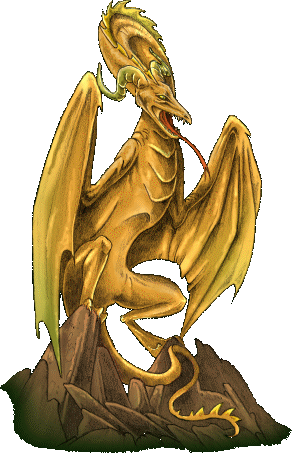
There is a good deal of difference between Dragon Species and Dragon Types. Dragon Types are not specific; they merely describe the physical appearance of the dragon. Dragon Species are more specific, namely to certain areas. For instance, Eastern Dragon is a dragon type; whereas, Ying Lung is a Dragon Species.
- Agathos Daimon
- Aitvaras
- Amphisbaena
- Aspises
- Basilisk
- Ch'i-lung
- Chiao
- Cockatrice
- Fuku-Riu
- Gowrow
- Guardians of the Gates of the Underworld
- Hai-riyo
- Han-Riu
- Horned Dragon
- Iaculi, The Egyptian Winged Serpent
- Jaculus
- Ka-Riu
- Kuniya
- Liru
- Lung
- Naga
- Palulukon
- P'an-lung
- P'eng-niao
- Pa Snake
- Peist
- Puk
- Taniwha
- Tatsu
- Xiuhcoatl
- Ying-Lung
- Zaltys
- Footnotes

The Oracle of Trophonios, who resided in Lebadeia, could only be visited by people who followed strict rituals. These rituals involved Agathos Daimon. This is perhaps the Greek equivalent to the gaurdian angel, but in serpent form; they were depicted as winged serpents and in other forms as a giant snakes.4
Afterward Christianity touched the region, the Aitvaras were seen as creatures that brought wealth, or creatures that brought on luck. However, in order to get one of these, it must be purchased with a person's soul from an Evil much like the Devil. The Aitvaras had to be born from the egg of a seven-year-old cockerel, and it would be hatched within the home (usually, when someone brought this egg home, they would not know what it was). After the hatching, only a truthful, God-loving person could rid it from their home, otherwise, the creature would remain.
It is said that the Aitvaras was to make the owner of it rich by any means necessary. Therefore, this creature would steal, generally from neighbors, and give it to the owner of the house. Obviously, the Aitvaras would need to be fed - but that was the only thing it required - omelettes. The owner would usually amass wealth through stolen gold, corn, and so forth, and almost always at the expense of his or her neighbors.
The first recording of the Aitvaras was in 1547, when a villager's wealth was in question. A more detailed story (not the same recording) described a young wife who wa curious about the fact that the corn barrel she had never ending or being empty. When she investigated, she found the Aitvaras, which left her house, for she was carrying a sacred candle.
According to its enviornment, Aitvaras changed how it looked. Sometimes it could be a normal animal, such as a cat (usually black in color) within a home or dwelling. However, it was said to take the shape of a fiery serpent or a flying dragon while outside.
Undoubtly, the Amphisbaena originated in Africa. When females try to hide their eggs, they keep on head awake and alert so that she may protect her young. This dragon is show usually as a serpent with two heads. Sometimes, however, this creature may have additional limbs such as feet, arms, and wings.
Read more about Ampisbaena.
The only way to avoid this creature's attack would be to sing or play music, which would tame the best and/or distract it. The Aspises did, however, create a bit of a counter reaction to music. They'd cover their ears (usually one ear would be to the ground while the other was plugged by its tail. Obviously, however, the creature could not attack in this position.
Looking at the Basilisk's eyes would kill. Thusly, in Christian art, the Basilisk is depicted as an evil creature of death. Killing a basilisk involves getting it to see its own reflection. Weasels are said to have a special talent with killing them in battle as well. Other things that a basilisks avoid include the herb rue, a patch of which could kill one, and the sound of a cock's crow.10
Read more about Eastern Dragons.
Sometimes they are also referred to as a basilisk. They are depicted with cock's head, comb and wattles, and a dragon's tail. In addition, they usually poses poisonous breath.15
The only creature that can avoid the cockatrice's deadly gaze is the weasel. And, while the weasel can kill the cockatrice in a battle, it is most likely so that the weasel will perish along side of its enemy. The only other known way to kill on is by using a mirror. Should this creature see its reflection, it will die instantly. Touching its dead body can be deadly as well.16
Read more about Eastern Dragons.
In the 1880s, the gowrow was blamed for the terrorizing Arkansas, namely rural areas. Fred Allsopp, who edited the Arkansas Gazette was said to have published many stories about the gowrow.19 Along with it's large size, reports said that it fed upon such creatures as goats and deer, and some say even humans.
In 1897, William Miller supposedly killed a gowrow, but no body was seen or reported to be seen. Miller's feat was reported in a newspaper. He waited for the monster near the gowrow's lair, and, when the creature appeared, people fled, as earthquakes announced its arrival. The gowrow emerged from the water, and then was killed.20
The Devil's Hole, near Boone Country, Arkansas, was a huge fissure. Since it was on his lands, E. J. Rhodes decided to explore it. When he could not do it alone, several men helped. They lowered a line with a piece of iron on it down into the fissure to see how far it would go, and it stopped around two hundred feet. This was no surprise - Rhodes had found a ledge in the fissure around that area before - but then strange things began to happen. There was a hissing noise that seemed to come from an angry animal. When they pulled the line up, the metal was bent. Three times, they tied a rock to the rope and threw it down, and, all three times, the rope was bitten in two. Legend had it that a dead Indian spirit was to blame, but others suspected the gowrow.21
Most had snake bodies, but different attributes such as the head and tails would change. For instance, some had around three snake heads while others had four legs. Still, others had wings.
Through each was a little different in appearance, they all were similar in the quality of snakes. They had thin, slender bodies.
In France, if there was a Guivre there was death and destruction. It was by chance that man discovered how to defeat the Guivre's deadly ways. You see, the Guivre are extremely bashful dragons. While they never hesitated to devour a clothed man, the creature always fled from a naked one, and the Guivre would always be blushing from the site.
The Guivre seemed to have all but disappeared from France. Perhaps they died out or perhaps they migrated.
Read more about Eastern Dragons.
For the most part, these creatures are a bit of a mystery. There is no reason for them to have wings. Some people believe they are similar to the Quetzalcoatl, but that dragon is found in a different culture from a different continent.
Having only two wings, they are said to be amphitere-like in appearance. Very little is known about them.
Read more about Eastern Dragons.
Naga seem to have come from India, and they are said to have lived underground in the Patala, a very watery region. The are semi-divine creatures, as they work with the gods.
They were patrons of clouds and water, and people seldom disturbed them. Why? They could cause droughts and flooding if they were displeased.
They are depicted as a serpent with the head of a human. They don't have wings, but they were sometimes know as shape-shifters, changing from humans to snakes at their will.
Read more about Nagas.
Read more about Eastern Dragons.
When the Palulukon are mistreated by humans, natural disasters tend to occur. Springs and rivers cease to flow, and earthquakes sometimes arise. This is much like the dragons of China. Palulukons are seen as weather creatures, in control of nature. They aren't seen as evil or good deities, only powerful ones.
Read more about Eastern Dragons.
Their are many alternative spellings for this dragon. These include: pukys, pukis, and puuk.
Taniwha are very vengeful dragons and when angered turn outright deadly.
Read more about Eastern Dragons.
Sometimes these creatures are represented as one. When this happens, it becomes a symbol of scorched earth. It is still unknown whether or not this was a singular creature, or several creature, though it is thought more often that the Xiuhcoatl were plentiful.
It is also important to note that this dragon type is also refered to as the Proper Conduct Dragon. The Ying-Lung are seen as guardians of the waters of the earth, and they are often seen and associated with the heavens and the clouds.
Read more about Eastern Dragons.
The zalciai were harmless and were protectorates. Sometimes it was said that, if you met a Zaltys, it would predict a marriage or a birth. They also helped with the fertility of the marriage and of the land.
A zaltys is never to be killed, as they are a symbol of life energy. Should anyone ever encounter one, they should simply let it pass in peace. Furthermore, they posses knowledge of healing and herbs.
To this day, Lithuanian women tend to carry dried snakes or pieces thereof for protection of diseases and to restore their eyesight. Roof crossbeams might also have carvings of these dragons.
- Agathos Daimon
- Giants, Monsters & Dragons by Carol Rose
- Agathos Daimon
- Agathos Daimon
- Lithuanian Folk Tales by Stepas Zobarskas
- Giants, Monsters & Dragons by Carol Rose
- The Book of Dragons & Other Mythical Beasts by Joseph Nigg
- What is a Dragon?
- Illiana the Golden Dragon (defunct)
- The Book of Dragons & Other Mythical Beasts by Joseph Nigg
- Giants, Monsters & Dragons by Carol Rose
- The Book of Dragons & Other Mythical Beasts by Joseph Nigg
- Giants, Monsters & Dragons by Carol Rose
- Illiana the Golden Dragon (defunct)
- The Bear Went over the Mountain: Tall Tales of American Animals by R. B. Downs
- Giants, Monsters & Dragons by Carol Rose
- The Bear Went over the Mountain: Tall Tales of American Animals by R. B. Downs
- Illiana the Golden Dragon (defunct)
- Eastern Dragons
- Illiana the Golden Dragon (defunct)
- The Book of Dragons & Other Mythical Beasts by Joseph Nigg
- Eastern Dragons
- The Kuniya and Liru
- Illiana the Golden Dragon (defunct)
- Naga: The Serpent
- Illiana the Golden Dragon (defunct)
- Giants, Monsters & Dragons by Carol Rose
- Illiana the Golden Dragon (defunct)
- Giants, Monsters & Dragons by Carol Rose
- Illiana the Golden Dragon (defunct)
- Macmillion Profiles: Myths and Legends. New York, Macmillion Library Reference. 2000.
- Illiana the Golden Dragon (defunct)
- Ophiolatreia
For more information, see the Bibliography.

Privacy Policy | Disclaimer |
Contact | Home
© Kylie 'drago' McCormick.
Last updated: 9 August 2008